Gonfalons
Relatively new to the pageantry of commencement is the use of colorful banners, called gonfalons, which represent the university’s colleges. Gonfalons have been used since medieval times as symbols of state. They originated in the republics of Italy. Each banner displays colors traditionally associated with its academic discipline. The gonfalons lead the processional, and each is carried by a student selected for the honor by their college.
Gonfalones
Hace poco se usan estandartes de colores en el desfile de graduación, llamados gonfalones, que representan las facultades de la universidad. Los gonfalones se usan desde épocas medievales como símbolos de estado. Se originaron en las repúblicas de Italia. Cada estandarte tiene los colores que se asocian tradicionalmente con su disciplina académica. Los gonfalones lideran la procesión y los lleva un estudiante seleccionado para dicho honor por su universidad.

Madison Shaw
Agricultural, Human, and Natural Resource Sciences

Yasamin Alazawi
Arts and Sciences

Isabelle Higginson
Business

Alyssa Smith
Education

Jacob Getchell
Engineering and Architecture

Nikita Schmitt
Nursing
University Mace
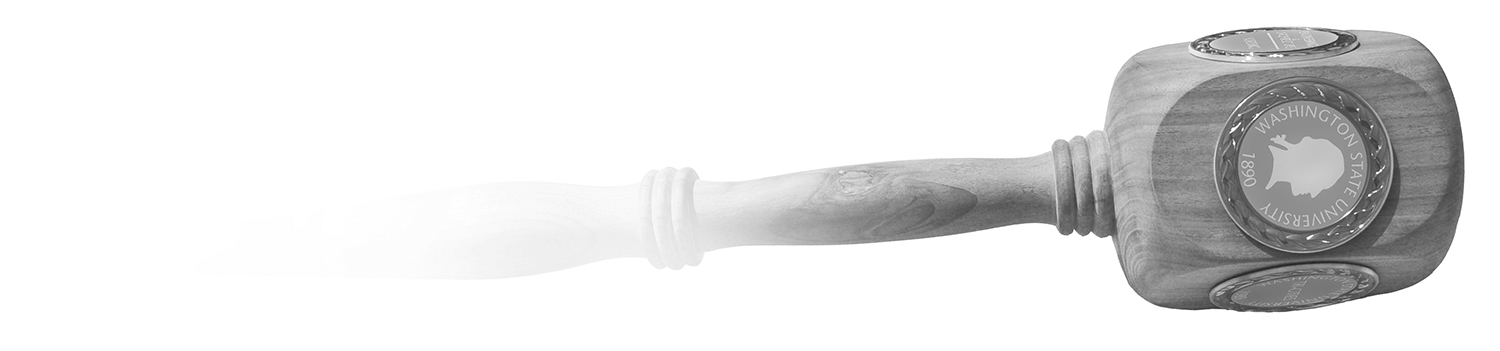
The University Mace, a traditional symbol of authority, will lead the faculty processional today. The WSU Tri-Cities Mace was designed and crafted by David Fassler of the WSU Tri-Cities Integrated Academic Technologies department. The 28-inch mace was carved from a walnut tree that had grown on his property in Pasco. Walnut was chosen to represent the strength and stability our campus gets from the greater Tri-Cities community. On the head of the mace, there are gold and silver medallions on each of the five sides: one engraved with the WSU seal, one engraved with a WSU Tri-Cities seal and three others engraved with the six colleges on the WSU Tri-Cities campus. When not in use for the commencement ceremony, the University Mace is housed in a display case at the south entrance to the East Building on the WSU Tri-Cities campus.
Centro de la Universidad
Hoy la procesión de la facultad estará liderada por el cetro ceremonial, un símbolo tradicional de autoridad. David Fassler, del Departamento de Tecnologías Académicas Integradas (Integrated Academic Technologies Department) de WSU Tri-Cities, diseñó y creó el cetro de WSU TriCities. El cetro de 28 pulgadas está esculpido a partir de madera de un nogal que creció en su propiedad de Pasco. Se escogió el nogal para representar la fuerza y estabilidad que nuestro campus recibe de la gran comunidad de Tri-Cities. En la cabeza del cetro, hay medallones de oro y plata en los cinco lados: uno tallado con el sello de WSU, otro tallado con un sello de WSU Tri-Cities y los otros tres, están tallados con las seis facultades del campus WSU Tri-Cities. Cuando no se usa para la ceremonia de graduación, el cetro de la universidad se guarda en una vitrina en la entrada sur del Edificio Este del campus de WSU Tri-Cities.

Mace Bearer
Portador del Cetro
The University Mace is carried by Professor Robin Ebert Mays, representative of the Washington State University Tri-Cities Faculty Senate.
La maestra Robin Ebert Mays, representante del Senado de Profesores de Washington State University Tri-Cities, portará el cetro de la universidad.

Graduate Greeting
Saludo a los Graduados
The graduate greeting will be presented by Yasmeen Lagunas, Vice-President of the Associated Students of Washington State University Tri-Cities.
Yasmeen Lagunas, vicepresidenta de los Estudiantes Asociados de Washington State University Tri-Cities, presentará el saludo a los graduados.